Both Propel Financing and Participate Energy use the commercial solar tax credit to deliver 30-40% upfront discounts with no upfront cash required. The right choice depends on your zip code, credit profile, and which program matches your home's numbers. Here is what you need to know.
When the residential solar tax credit expired at the end of 2025, a new category emerged: the prepaid lease (also called a prepaid ESA or solar service agreement). A third party holds ownership long enough to claim the commercial ITC, then passes those savings to you as an upfront discount before transferring ownership. Propel Financing and Participate Energy are two leading programs built on this structure. Both deliver meaningful discounts. The right choice depends on your zip code, credit profile, and which program's numbers are better for your home.
A prepaid ESA bundled with a Concert Finance loan. No upfront cash required. The commercial tax credit discount is applied to your financed amount from day one at 29.8% standard or 39.2% in Energy Community zip codes. Fixed 25-year payments, 0% dealer fees, and system ownership transfers at Year 5 via the Early Buyout Option. Best fit for homeowners in Energy Community areas who qualify for the higher discount.
A prepaid lease delivering a 30% upfront discount through the same commercial ITC pass-through structure. Includes the Tesla Powerwall 3 at a competitive price point and requires no credit check. Participate is expanding into more markets than Propel, including Massachusetts, New Jersey, and Texas. Best fit for homeowners outside Energy Community zip codes, or those who want no credit underwriting.
A third party owns the system and sells you the power or equipment use at a monthly rate. You never own the system and many contracts include annual escalators that erode your savings over time.
You own the system from day one, but no tax credit is available to homeowners after 2025. Dealer fees of 15-25% are typically buried in the loan, meaning you borrow more than the system is worth and pay interest on that markup for decades.
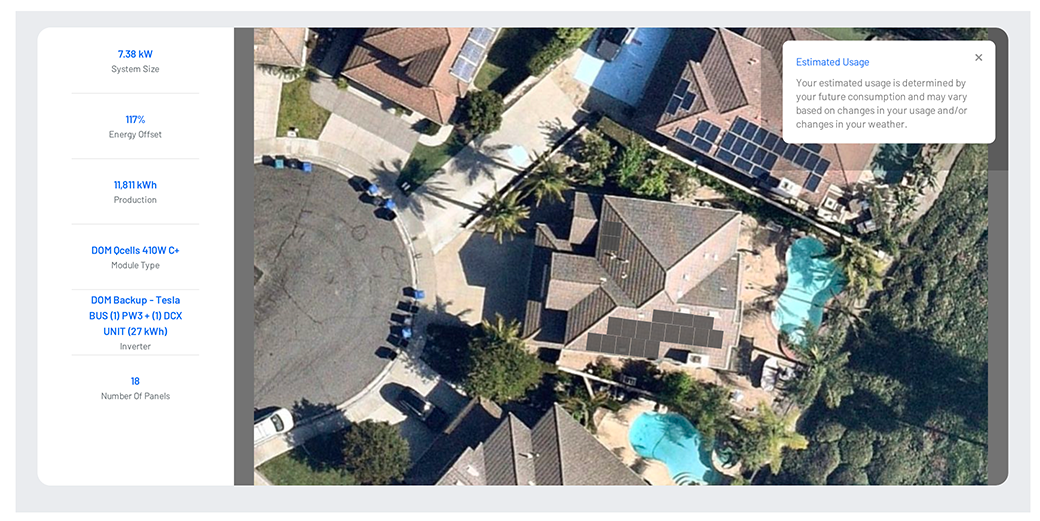
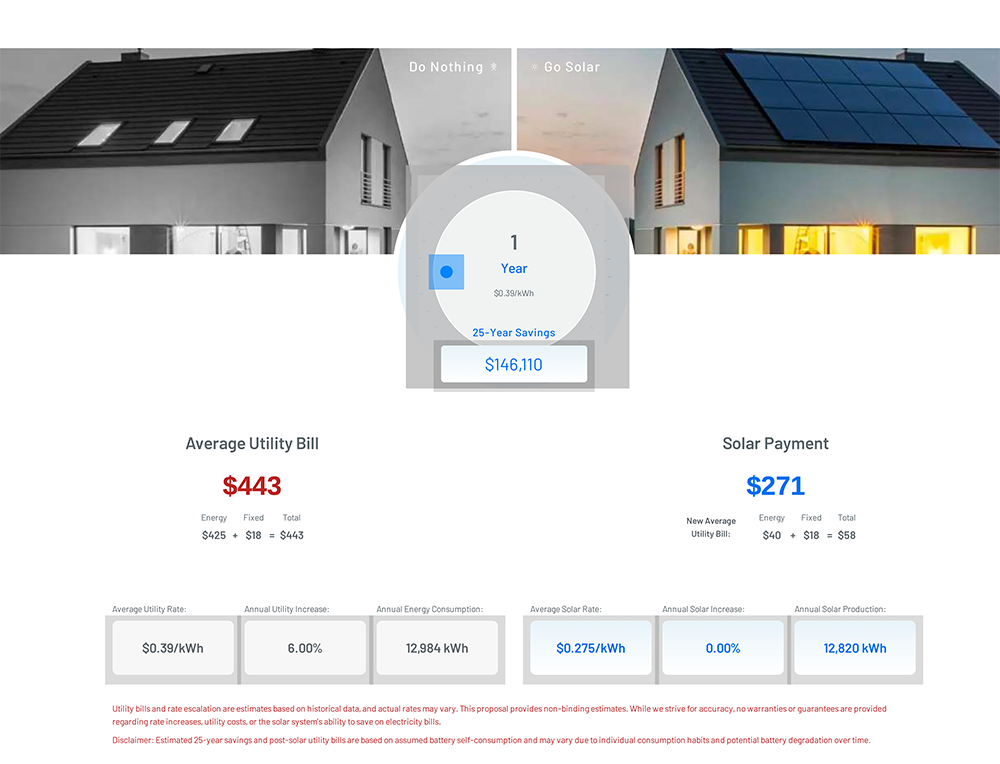
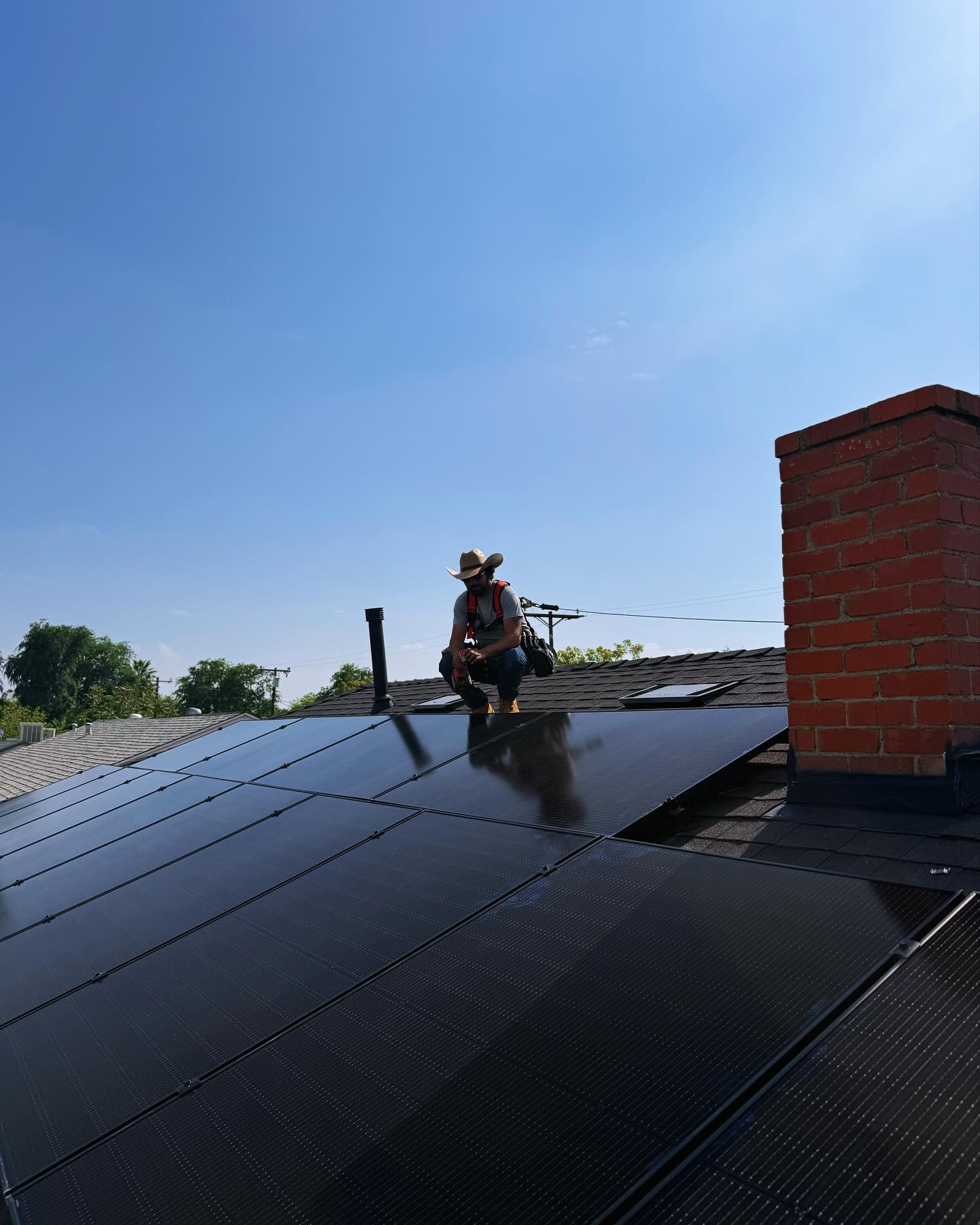
These are actual proposal screenshots from a single Southern California home. Same 7.38 kW system, same 18 panels, same $426/mo utility bill at $0.51/kWh. Two different programs, two different numbers. This is what a side-by-side comparison actually looks like.
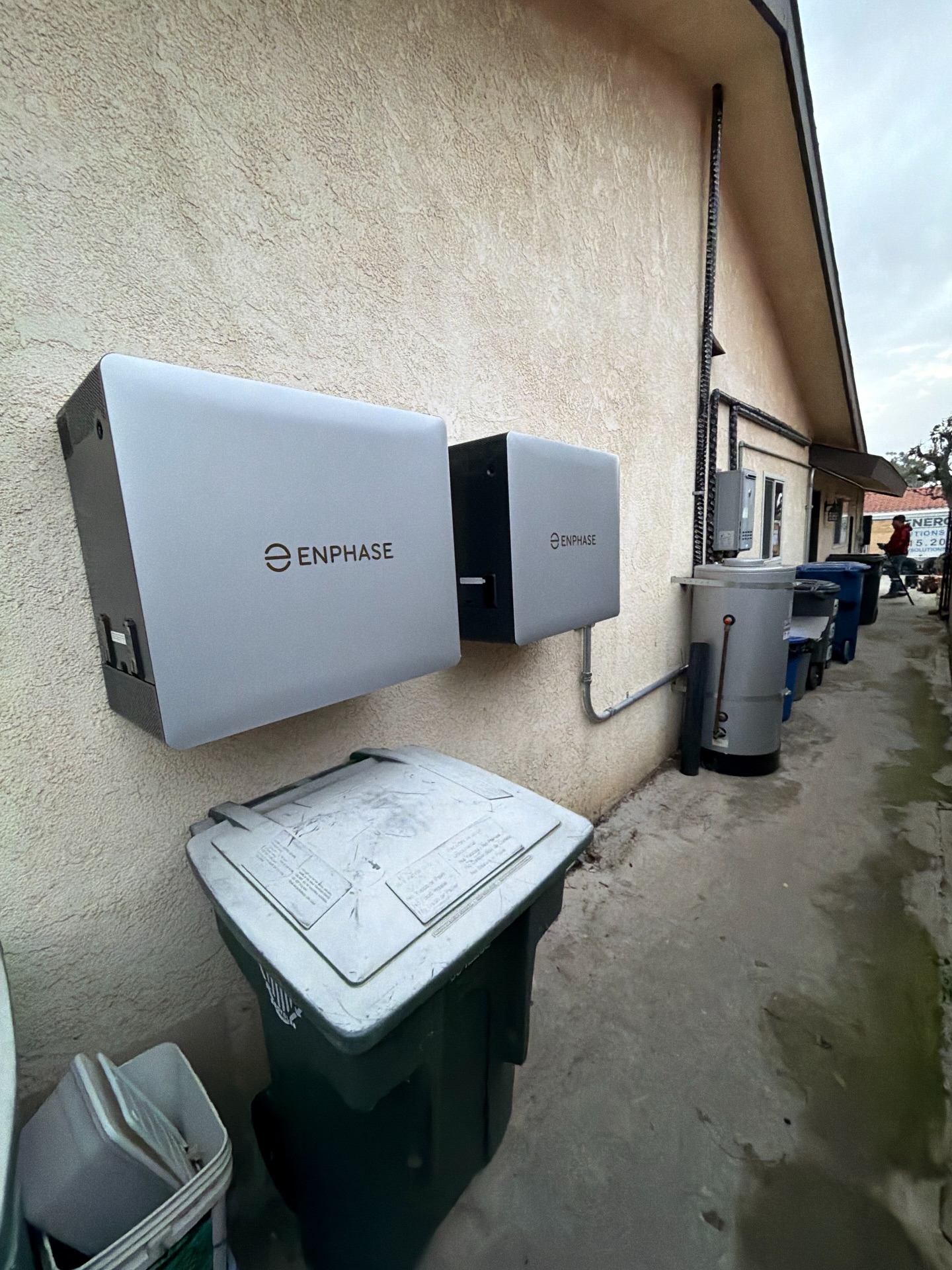
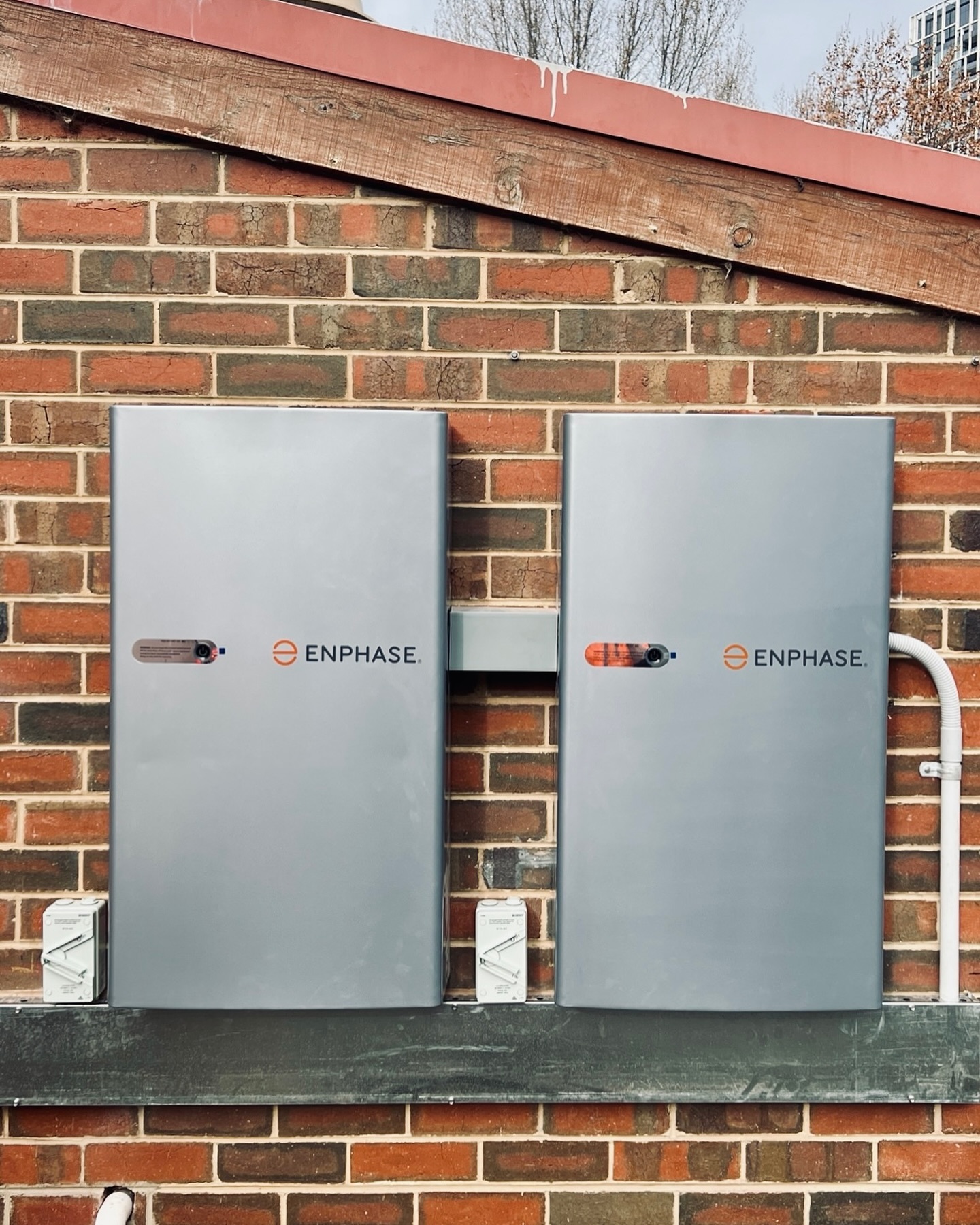
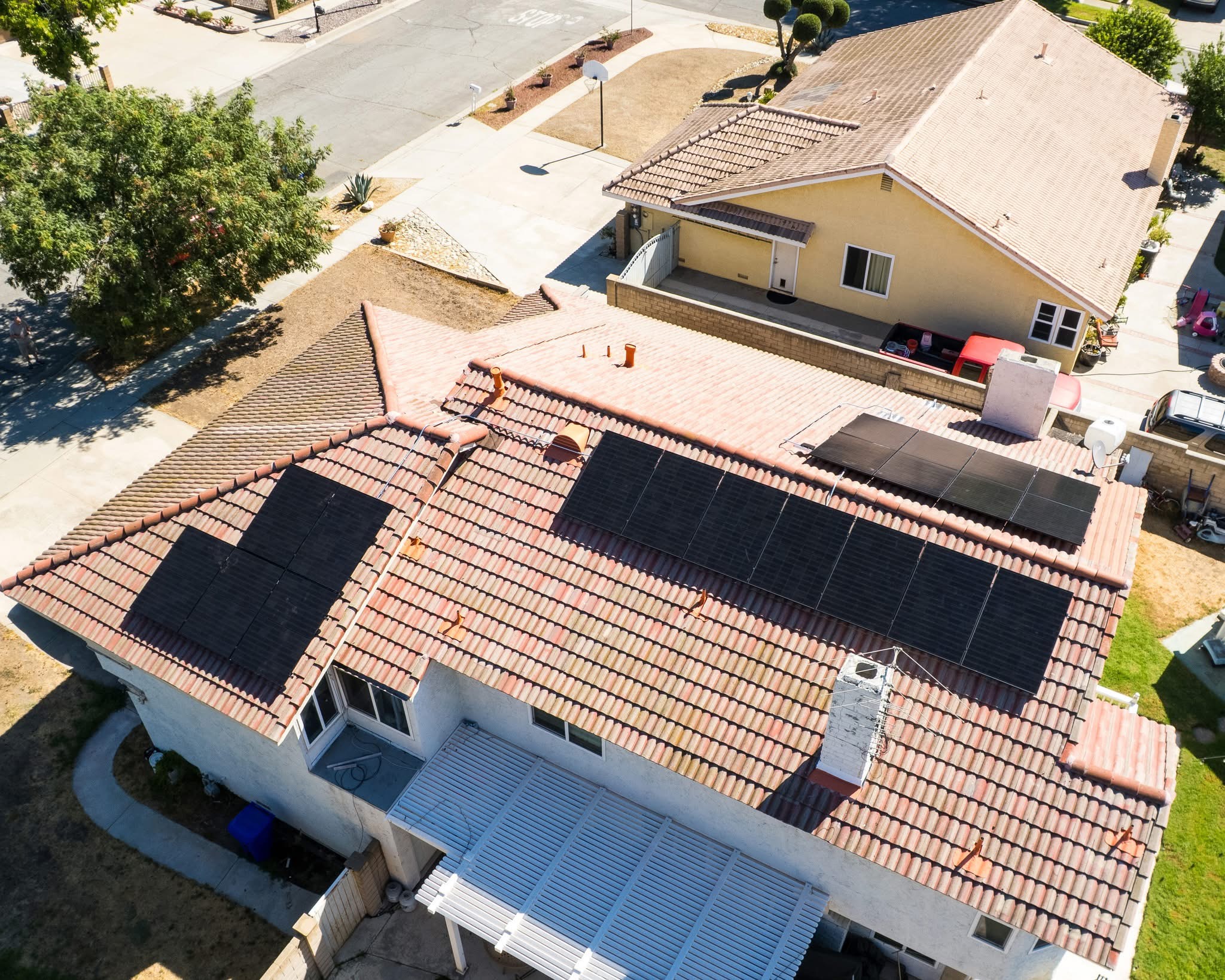
Both proposals show the same rooftop and system size. The hardware differs: Propel uses Enphase IQ8HC microinverters with Enphase IQ Battery 5P storage. Participate uses Tesla Powerwall 3 with DCX expansion. The lower Tesla PW3 hardware cost is what brings Participate's starting system price in lower.
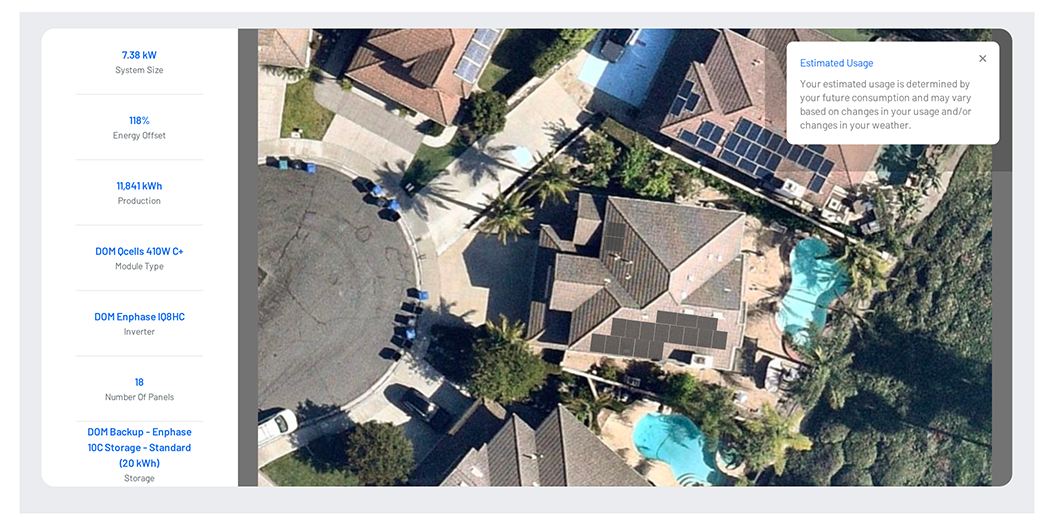
Same home, same roof, same 18 panels. Propel shows Enphase IQ8HC + IQ Battery 5P (20 kWh). Participate shows Tesla Powerwall 3 + DCX unit (27 kWh total storage). The PW3's integrated inverter and higher capacity per unit is why the starting system price differs between proposals.
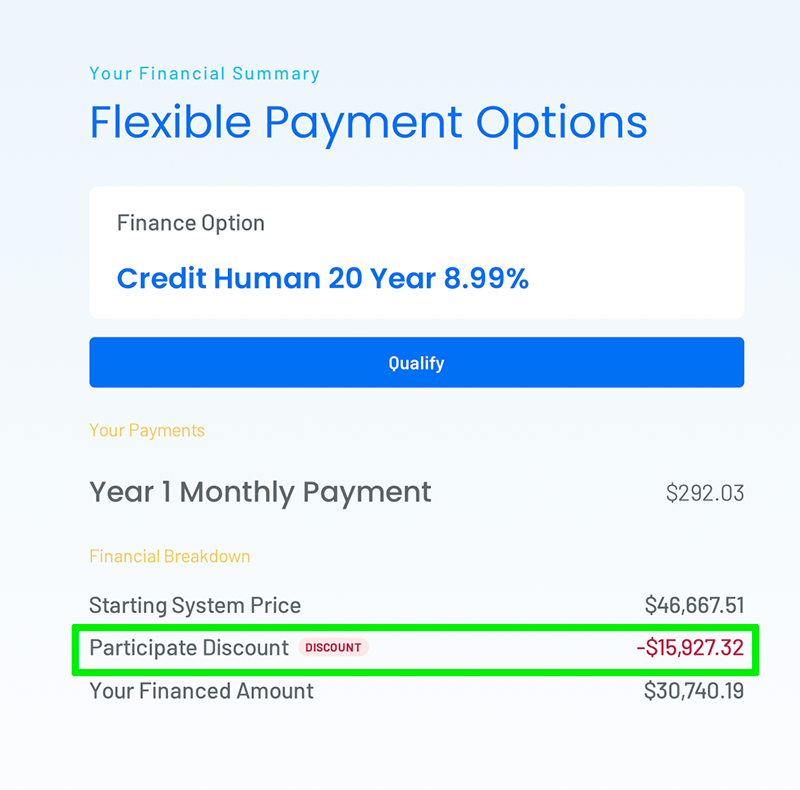
This is the most important comparison. Both proposals show the starting system price, the discount applied before financing, and the financed amount that becomes the loan balance. The address is not in an Energy Community, so both discounts are at the standard tier.
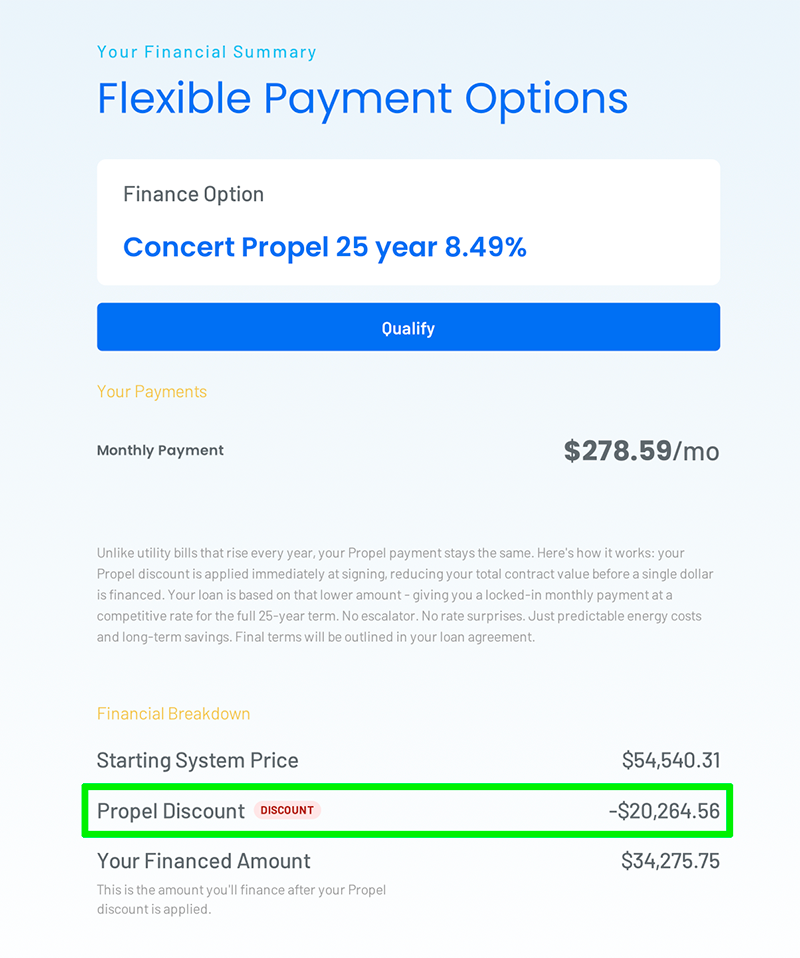
Propel: $54,540 starting price minus $20,264 discount (37.2%) = $34,275 financed at 8.49% APR, 25 years = $278.59/mo. Participate: $46,667 starting price minus $15,927 discount (34.1%) = $30,740 financed at 8.99% APR, 20 years = $292.03/mo. The lower Participate starting price is what makes its effective rate competitive despite the higher APR.
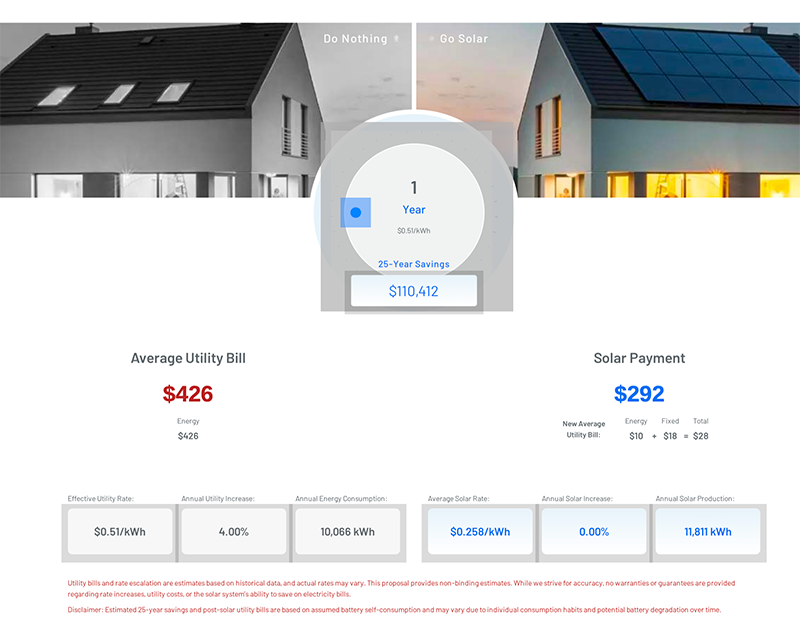
Both proposals show the same $426/mo utility bill before solar. Here is what the new monthly picture looks like under each program. The solar payment replaces most of the utility bill, with a small residual charge remaining for grid connection and any excess usage.
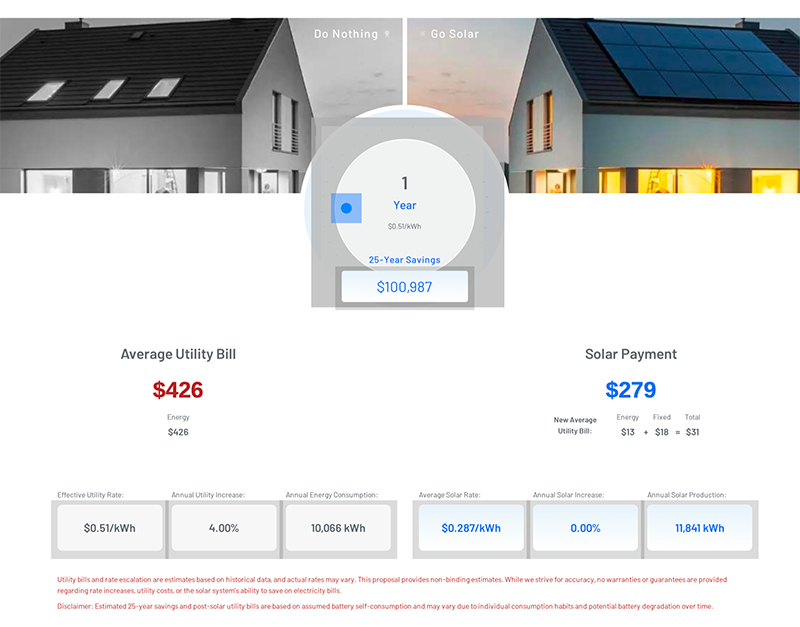
Propel: $279/mo loan payment + ~$31 residual utility = ~$310 total. Participate: $292/mo loan payment + ~$28 residual utility = ~$320 total. Both are meaningfully below the $426 utility-only baseline, with no escalation on the solar payment for the full loan term.
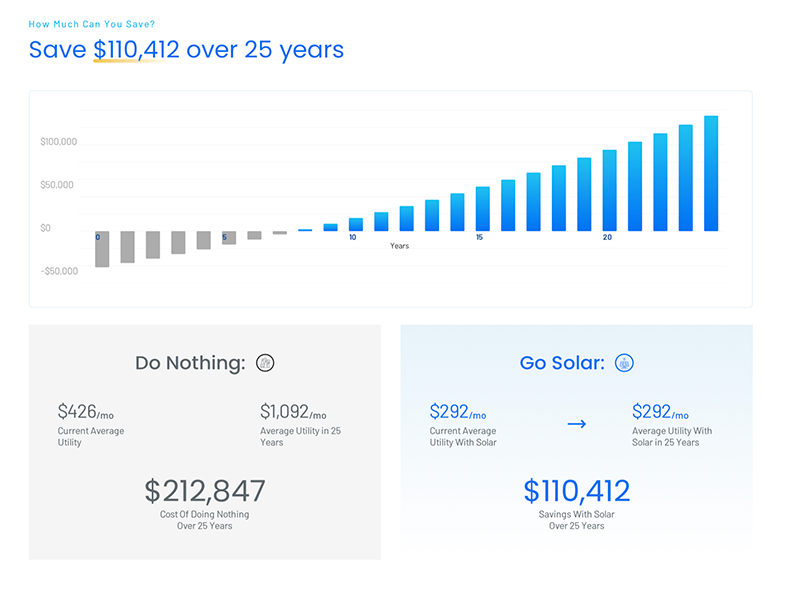
Both charts assume the same utility rate escalation at 4%/yr. The solar payment stays fixed while the utility comparison line keeps climbing. The result is a widening savings gap every year. Because this address is not in an Energy Community, Participate's lower starting system price produces a better 25-year savings outcome despite the higher APR.
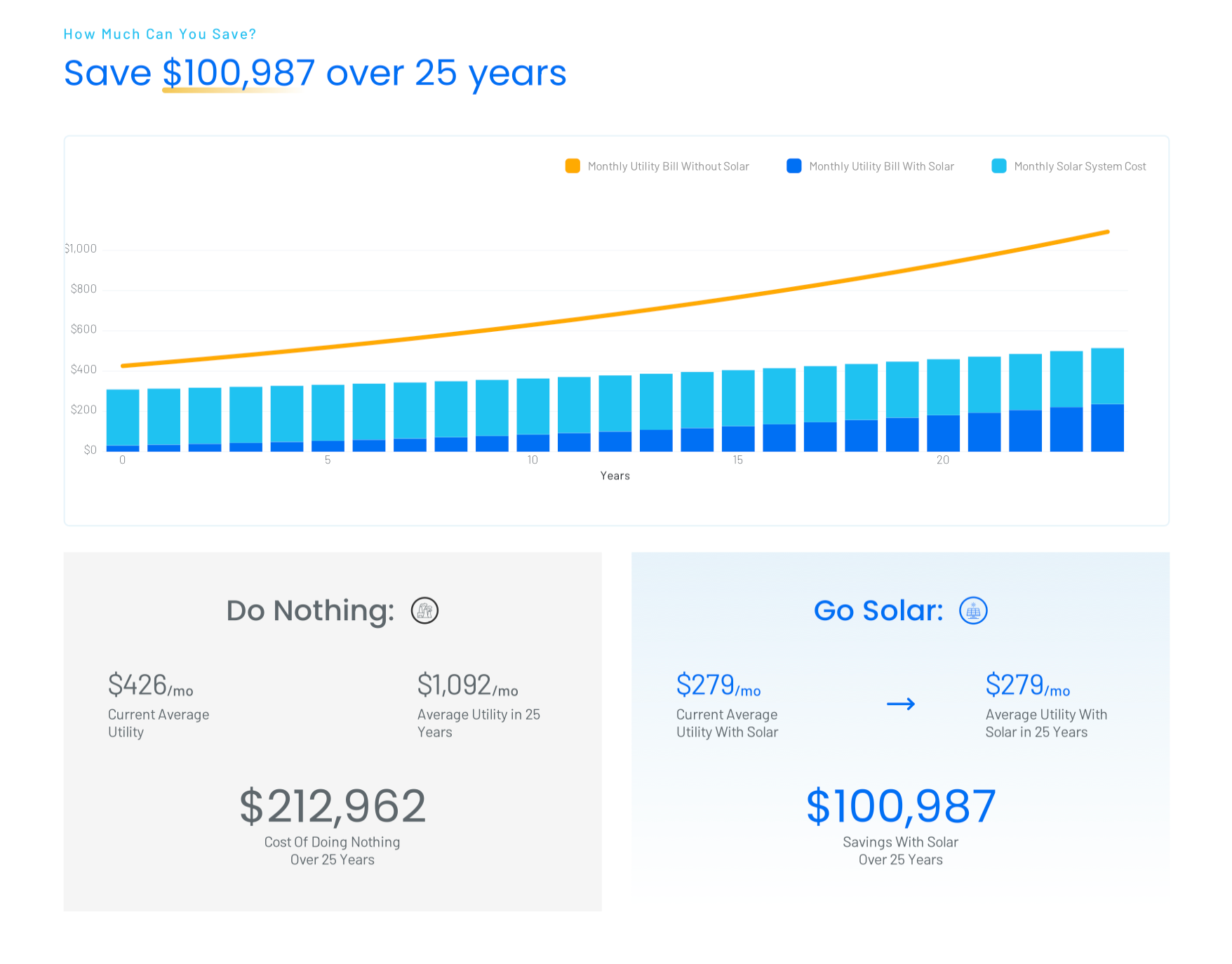
On this non-Energy Community address, Participate saves $9,425 more over 25 years than Propel. In an Energy Community zip code, the 39.2% Propel discount would shift this outcome the other direction. This is why we run both quotes before presenting a recommendation.
| Data Point | Propel (Enphase) | Participate (Tesla PW3) |
|---|---|---|
| Starting System Price | $54,540 | $46,667 |
| Discount Applied | $20,264 (37.2%) | $15,927 (34.1%) |
| Financed Amount | $34,275 | $30,740 |
| Loan Rate / Term | 8.49% / 25 years | 8.99% / 20 years |
| Monthly Solar Payment | $278.59 | $292.03 |
| Residual Utility Bill | ~$31/mo | ~$28/mo |
| Total Monthly Energy Cost | ~$310 | ~$320 |
| Battery Storage | Enphase IQ Battery 5P (20 kWh) | Tesla PW3 + DCX (27 kWh) |
| 25-Year Savings (non-EC zip) | $100,987 | $110,412 ▲ |
| Winner on this address | Non-EC zip favors Participate | Better here |
This address is in Mission Viejo, CA (SCE territory) and is not in a federally designated Energy Community zip code. In an Energy Community zip code, Propel's 39.2% discount would reduce the financed amount further and flip the savings comparison. We verify Energy Community status using the Baker Tilly tool at the project address level before presenting program recommendations.
This table covers the five main financing structures available to homeowners in 2026. The primary comparison is Propel vs. Participate, both prepaid lease programs that pass through the commercial ITC. Traditional alternatives are included for full context.
| Feature | Propel by Concert Finance | Participate Energy (Prepaid Lease + Tesla PW3) |
Stellar Solar (Prepaid ESA) |
Traditional Solar Loan | Traditional PPA / Lease |
|---|---|---|---|---|---|
| Upfront Cash Required | $0 | $0 via Credit Human loan | Varies by program | $0 (but dealer fees inflated into loan) | $0 |
| Monthly Payments | Fixed loan payment, no escalation | Fixed Credit Human loan payment, no escalation | None after prepayment | Fixed or variable loan payment | Monthly lease or per-kWh PPA rate |
| Payment Escalation | ✓ 0% Always | ✓ None after prepay | ✓ None after prepay | ✓ Fixed rate loans | ✗ Many have 2-3% annual escalator |
| Upfront Discount | 30–39.2% off system cost | 30% off system cost | Up to 30% off | None (dealer fees add 15-25%) | None |
| Energy Community Bonus | +9.2% extra (39.2% total) | ✗ Not offered | ✗ Not offered | ✗ Not available | ✗ Not available |
| Dealer Fees | ✓ 0% Dealer Fee | N/A | N/A | ✗ Typically 15-25% | N/A |
| Ownership Transfer | Year 5 via Early Buyout | Year 6+ at fair market value | Varies by contract | Owned at signing | ✗ Rarely or never |
| Ownership Transfer Cost | Included in loan (no extra payment) | "Fair market value" at time of transfer | Contract-dependent | N/A (already owned) | Purchase option often costly |
| Loan Term | 25 years fixed | 25-year ESA (separate loan if financed) | Varies | 10-25 years | 20-25 year lease/PPA term |
| Reamortization Options | 3 free reamortizations | Not offered | Not offered | Rare | N/A |
| Prepayment Penalty | ✓ None | ✓ None | Varies | Varies by lender | Often yes (buyout clauses) |
| Performance Guarantee | ✓ Yes, included | Varies by contract | Varies | ✗ No | Sometimes |
| Monitoring & Maintenance | ✓ Yes, included | ✓ Yes, included | ✓ Yes, included | ✗ Homeowner's responsibility | ✓ Yes |
| Credit Check Required | Yes 660 min FICO (680 TX/FL) | None required | None required | Yes varies by lender | Sometimes / soft check |
| Min Loan / Financing Amount | $10,001 | No stated minimum | No stated minimum | Varies | N/A |
| Max Loan / Financing Amount | $135,000 | $75,000 prequalified ($135,000 with docs) | Varies | Varies | N/A |
| ACH / Autopay Discount | 0.50% APR reduction | N/A | N/A | Varies | N/A |
| Battery Storage Available | ✓ Yes (Enphase) | ✓ Yes | ✓ Yes | ✓ Yes (extra cost) | Some providers |
| Transferable on Home Sale | ✓ Yes (loan + ESA together) UCC-1 on equipment surfaces on title; must be assumed, paid off, or subordinated at closing |
✓ Yes (no credit check) No UCC filing per program structure; Credit Human loan assumed or paid off at closing |
Varies | ✓ Loan assumption UCC-1 on equipment typical; must be cleared at closing |
Usually yes Solar company must approve transfer; buyer refusal is common |
| Property Types | SFR, multi-unit (up to 4), 2nd homes | SFR (no condos, townhomes, mobile homes) | SFR primary | SFR, investment properties | SFR, some condos |
| Domestic Content Required | Yes (Qcells, Enphase, approved racking) | Varies by state | Not specified | ✗ No requirement | Some providers |
Sources: Concert Finance Propel Training Deck 2025, participate.energy, stellarsolar.net, energysage.com. Competitor data reflects publicly available terms as of early 2026 and is subject to change. Propel terms are finalized at application and may vary by state and project. Consult your solar advisor for current program details.
Propel's pricing varies by state based on Energy Community designation and local pricing caps. Here are real example project numbers from Concert Finance's 2025 training materials.
| State | Propel Price (Financed Amount) | Full System Cost | Upfront Discount | Monthly Payment (8.99% APR, 25 yr) | vs. Standard Loan at Same APR |
|---|---|---|---|---|---|
| California | Custom (up to $4.85/W PV pricing cap) | Varies | 25-37% | Calculated at signing | Lower |
| Arizona (Energy Community) | $25,185 | $40,000 | $14,815 (37%) | $214/mo | vs. $339/mo standard loan |
| Texas (Energy Community) | $23,717 | $40,000 | $16,283 (41%) | $201/mo | vs. $339/mo standard loan |
| Maine (Energy Community) | $23,404 | $40,000 | $16,596 (41%) | $198/mo | vs. $339/mo standard loan |
Example projects assume 10kW solar + 10kWh battery at $3.00/W solar and $1,000/kWh battery pricing. Energy Community eligibility determined at application. All figures from Concert Finance Propel Training Deck 2025 (proprietary and confidential). Actual amounts financed depend on project cost, state, and Energy Community status confirmed at signing.
A real Propel proposal showing the homeowner's current utility bill next to their new fixed Propel payment. The discount is applied before the loan, so the payment is lower from month one with no escalation over 25 years.
Propel offers both a Standard APR and a Results Based Pricing (RBP) option that rewards excellent credit. All options carry a 0% dealer fee. Enrolling in ACH autopay at signing reduces the APR by 0.50% for the life of the loan. The Suzanne Morgan proposal above used the 8.49% rate, which is the Standard APR with ACH autopay applied.
| Pricing Tier | APR (Standard) | APR with ACH Autopay | Dealer Fee | Payment Factor (25 yr) | Credit Tier |
|---|---|---|---|---|---|
| Standard APR | 8.99% | 8.49% | 0.00% | 0.00848 | N/A (all qualifying credit) |
| Results Based Pricing (RBP) Excellent | 7.79% | 7.29% | 0.00% | 0.00765 | Excellent credit |
| Results Based Pricing (RBP) Very Good | 8.79% | 8.29% | 0.00% | 0.00834 | Very good credit |
| Results Based Pricing (RBP) Good | 9.79% | 9.29% | 0.00% | 0.00904 | Good credit |
Results Based Pricing is mandatory in Texas and Florida. ACH autopay (enrolled at signing via Plaid) reduces APR by 0.50% for the life of the loan, saving an estimated $1,300-$1,800 over the 25-year term. Source: Concert Finance Propel Training Deck 2025.
Here is a closer look at each program so you can compare apples to apples before making a decision. Note that "prepaid lease" and "prepaid ESA" are often used interchangeably by different companies. The structural difference between them is smaller than the marketing suggests.
Each of these advantages exists somewhere in the market. Propel is the only program that delivers all five in a single integrated product.
Every traditional solar lender buries a dealer fee of 15-25% into the financed amount. Propel charges 0%. On a $40,000 system that is $6,000-$10,000 in markup you never borrow against.
Homeowners in IRS-designated Energy Communities receive an additional 7% tax credit adder on top of the base 30%, bringing the effective discount to 37%. No competitor in this space passes this adder to homeowners.
The IRS requires a third-party owner to hold the system for 5 years to avoid tax credit recapture. Propel transfers ownership via Early Buyout at the earliest legal date, included in the loan. Compete programs push this to Year 6 or later and charge "fair market value."
Propel bundles the prepaid ESA and the Concert Finance loan into one product. Participate pairs a prepaid lease with a separate Credit Human loan application. Propel also includes up to 3 free reamortizations, an autopay APR reduction, and a 25-year term vs. Participate's 20 years, giving more payment flexibility over a longer horizon.
Propel includes up to three free loan reamortizations. If rates drop or your financial situation changes, you can restructure your payment without refinancing fees. No other residential solar loan in this category includes this feature.
This is one of the most common questions homeowners ask before signing. The short answer: both Propel and Participate are designed to be handled at closing, either through assumption by the buyer or payoff by the seller. Here is how each program and alternative works in practice.
Concert Finance files a UCC-1 financing statement on the solar equipment itself (the panels, inverters, and battery). Technically this is a security interest in personal property, not a lien on the home or real estate. However, in practice it shows up during a title search and must be addressed before the transaction closes. Title companies and buyers' mortgage lenders routinely require it to be either assumed, paid off, or formally subordinated before they will clear title. If you refinance before paying off the loan, the same subordination process applies.
Option 1 Assumption: The buyer assumes the remaining Propel loan and ESA. Concert Finance must approve the transfer. The seller is released from the obligation at closing. Confirm current assumption terms and any processing fees with your Propel advisor at time of sale.
Option 2 Payoff: The seller pays off the remaining loan balance at closing from sale proceeds. No prepayment penalty. The UCC filing is released and the system transfers with the home as an owned asset, which can support a higher appraised value.
Before Year 5: Concert Finance still holds commercial ownership under the ESA. The buyer assumes the ESA and remaining loan, or the seller pays off the loan and completes the ESA buyout to transfer full ownership. Consult your Propel advisor for current terms.
Practical tip: Notify your listing agent and title company as early as possible. The UCC filing is not a mortgage lien and cannot trigger foreclosure, but unfamiliar agents and lenders sometimes treat it as more complicated than it is. Getting ahead of it prevents closing delays.
Per the Participate prepaid lease structure, no UCC-1 financing statement is filed on the solar equipment. This means the filing does not surface during a title search the way a Propel or traditional solar loan would. The Credit Human loan is still a financial obligation that must be addressed at closing, but it does not create the same title-level disclosure that triggers lender subordination requests or agent flags. Confirm the absence of any UCC filing in your specific contract documents at time of signing.
Option 1 Assumption: The buyer can assume the Credit Human loan and prepaid lease. Because Participate requires no credit check, the assumption process is typically more straightforward than a Propel loan transfer. Confirm current assumption terms with your advisor at time of sale.
Option 2 Payoff: The seller pays off the remaining Credit Human loan balance at closing. No prepayment penalty. The system transfers to the buyer as an unencumbered asset.
Year 6 purchase option: If the seller has reached Year 6 and exercised the purchase option before listing, the system is fully owned outright with no loan or lease obligation to address at sale.
The absence of a UCC filing is a genuine practical advantage for listing agents and title companies, particularly in markets where solar financing disclosures are less routine. That said, always disclose the existence of the Credit Human loan to your agent so it can be factored into the closing timeline.
Owned solar systems sell with the home as real property with no assumption, no payoff, no lien. Research by Lawrence Berkeley National Laboratory and Zillow consistently shows owned solar adds $15,000 to $30,000+ to a home's appraised value depending on system size and location.
Nothing to disclose beyond standard solar panel presence. The buyer inherits the system, the warranties, and the savings. Most buyers in California view owned solar as a positive asset, not a complication.
Most traditional solar loans file a UCC-1 financing statement on the solar equipment. Like Propel, this is technically a security interest in personal property rather than a lien on the home itself, but it surfaces in title searches and buyers' mortgage lenders typically require it cleared or subordinated before closing. The process at sale is similar to Propel: assumption or payoff. The key difference is that traditional loans are often larger (no upfront discount was applied) and often include dealer fee markup buried in the principal, meaning the payoff balance is higher relative to actual system value.
Some lenders use unsecured personal loan structures that do not require a UCC filing. Check your loan documents to confirm which type you have.
PPAs and traditional leases are consistently the most problematic solar product for home sales. The solar company still owns the system, so the buyer must either agree to assume the PPA/lease contract, or the seller must pay a buyout to the solar company before closing.
Buyers sometimes refuse to assume an active PPA, which can delay or kill a sale. Real estate agents and title companies often flag active solar leases and PPAs as items requiring careful attention during escrow. The escalator clauses common in PPAs mean the buyer is also inheriting a rising cost, not a fixed one.
If the PPA buyout amount is high (common in older SunPower and Sunrun agreements), the seller may net less from the sale than if they had not installed solar at all.
Bottom line: Both Propel and Participate are designed to be handled cleanly at closing. Propel's Concert Finance loan comes with a UCC-1 filing on the solar equipment - technically not a lien on the home, but one that surfaces on title and must be addressed via assumption, payoff, or subordination. Participate's structure avoids this filing entirely per its program design, which simplifies the title process. Neither program requires buyer credit approval for the ESA assumption. Propel has no prepayment penalty, so a payoff at closing is always available. Always notify your listing agent and title company early so the process is built into the transaction timeline rather than discovered at escrow.
Coverage is one of the most important factors when comparing ESA programs. Propel is available in the largest utility states and is actively expanding.
Note: Propel's market list is from Concert Finance's 2025 training materials. Competitor state counts reflect publicly available program pages and may not reflect all active geographies.
Both programs use the same commercial tax credit structure to deliver meaningful upfront discounts. The best fit depends on a few simple factors. Here is the short version.
The simplest way to decide: Request a side-by-side proposal for both programs on your home. The numbers will tell you which option saves more. Our advisors can run both scenarios in one conversation.
Get a side-by-side look at Propel and Participate for your specific address. Takes about 2 minutes.