Solar in California makes financial sense for many homeowners because of high electricity costs, strong production, and new financing models like Propel and Participate that create significant upfront discounts unavailable through standard residential loans. Here we compare both programs side by side with real proposal numbers.
The federal residential solar tax credit was phased out for homeowners in 2026. The Propel Loan by Concert Finance preserves access to a commercial-equivalent clean energy credit through a temporary commercial ownership structure during years one through five — creating a 30–40% upfront discount that most residential financing options can no longer offer. This page compares all major California solar financing paths side by side so you can see the full picture.
Typical 7.4 kW system with battery storage in California. Both Concert Finance ownership programs are highlighted because they share a structural tax credit advantage unavailable to standard residential financing after 2026. The program that performs better for a given home depends primarily on whether the address falls inside a federally designated Energy Community zip code.
| Financing Option | Monthly Payment | 25-Yr Net Savings | Best Fit |
|---|---|---|---|
|
⚡ Propel Loan (Concert Finance)
25-yr fixed loan. Concert holds commercial ownership years 1–5 to unlock clean energy tax credits, passed to you as an upfront discount. Enphase IQ8HC + IQ Battery 5P standard.
|
$250–$295 Fixed 25 yrs, no escalator |
$100K–$115K | Best in Energy Communities Energy Community and domestic content bonuses stack on top of the storage tier |
|
⚡ Participate Prepaid Lease
20-yr Credit Human loan. Same Concert Finance commercial structure, 30% upfront discount. Tesla Powerwall 3 standard. Purchase option at Year 6.
|
$265–$300 Fixed 20 yrs, no escalator |
$95K–$110K | Best Outside Energy Communities Tesla PW3 lowers starting price, improving savings in standard zip codes |
|
Cash Purchase
Pay full project cost upfront, no monthly financing payment.
|
$0/mo Break-even ~Year 10 |
$125K–$135K | Best lifetime ROI for homeowners comfortable deploying capital upfront |
|
Traditional Solar Loan
Full project amount financed at full price. Ownership from day one.
|
$330–$365 Higher than Propel/Participate |
$70K–$80K | Works for ownership-focused buyers comfortable with a higher monthly cost |
|
PPA (Power Purchase Agreement)
Pay for power produced. No system ownership ever.
|
$220–$260 Starting rate, rises 2–3%/yr |
$30K–$45K | Lower barrier to entry, but no equity built and escalator erodes savings over time |
|
No Solar
Continue paying rising utility bills indefinitely.
|
$250–$400+ Rises ~4–6%/yr |
-$75K to -$110K | Typically the highest 25-year total spend of any path on this list |
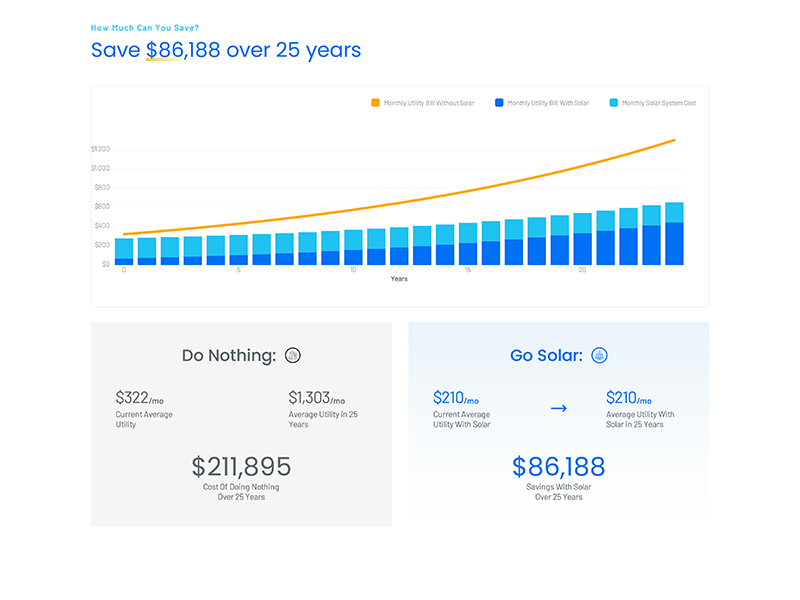
The chart below plots each financing option's cumulative net position over 25 years. Year 1 avoided utility cost is assumed at $4,300, growing at 4% annually with 0.5% system degradation.
The two tables below are pulled directly from real dual proposals run on the same Southern California home. They show exactly what each program looks like on paper so you can see the difference in structure, payment, and long-term savings.
| Line Item | Amount | Notes |
|---|---|---|
| Starting System Price | $54,540 | Qcells 410W panels + Enphase IQ8HC microinverters + Enphase IQ Battery 5P (20 kWh) |
| Propel Discount | -$20,265 (37.2%) | Commercial ITC + MACRS accelerated depreciation benefit passed to homeowner at signing |
| Financed Amount | $34,276 | This is what gets financed. Not the full system price. |
| Loan Term / Rate | 5 to 25 years / 8.99% APR* | Fixed rate, no escalator, no prepayment penalty, up to 3 free reamortizations |
| Monthly Payment | $278.59/mo | Fixed for the full 25-year term |
| Post-Solar Utility Bill | ~$31/mo | Residual grid charges (fixed + minimal energy) |
| New Total Energy Cost | ~$310/mo | Down from $426/mo utility-only scenario |
| Ownership Transfer | Year 5 | Auto-transfer per program terms |
| Projected 25-Year Savings | $100,987 | vs. continuing to pay $0.51/kWh with 4%/yr escalation |
| Average Solar Rate | $0.287/kWh | Effective rate including loan payment, locked for 25 years |
| Line Item | Amount | Notes |
|---|---|---|
| Starting System Price | $46,667 | Qcells 410W panels + Enphase IQ8HC microinverters + Tesla Powerwall 3 (27 kWh, 1 unit + DCX) |
| Participate Discount | -$15,927 (34.1%) | Same commercial ITC + MACRS structure. Lower starting price reflects Tesla PW3 hardware cost. |
| Financed Amount | $30,740 | Credit Human 20-year loan |
| Loan Term / Rate | Up to 240 months / 8.99% APR | Fixed rate, no dealer fee, no prepayment penalty. No FICO minimum on the lease itself; Credit Human financing is separately underwritten. No lien on the home. |
| Monthly Payment | $292.03/mo | Fixed for the full 20-year term |
| Post-Solar Utility Bill | ~$28/mo | Residual grid charges (fixed + minimal energy) |
| New Total Energy Cost | ~$320/mo | Down from $426/mo |
| Ownership / Purchase Option | Year 6 | Purchase option available at Year 6. No UCC filing on title. |
| Projected 25-Year Savings | $110,412 | Higher than Propel in this case because the lower starting system price produces a better financed amount despite higher APR |
| Average Solar Rate | $0.258/kWh | Lower effective rate than Propel in this non-Energy Community scenario |
The equipment in a Concert Finance proposal is not generic. Both programs use premium-tier hardware with manufacturer warranties that match or exceed the loan term. Here is what comes with each.
| Feature | Propel (Enphase) | Participate (Tesla PW3) |
|---|---|---|
| Solar Panels | Qcells 410W | Qcells 410W |
| Inverter Type | Enphase IQ8HC microinverters (per panel) | Tesla PW3 integrated inverter |
| Battery Storage | Enphase IQ Battery 5P (LFP, modular) | Tesla Powerwall 3 + DCX Expansion |
| Battery Warranty | 15 years | 10 years |
| Panel-Level Monitoring | Yes (per microinverter) | System-level |
| Expandable Storage | Yes (add IQ5P units) | Yes (DCX units) |
| FICO Requirement | 660 minimum | None |
| UCC Lien on Title | Yes (standard for financing) | No |
| Loan Term | 25 years | 20 years |
| Ownership Transfer | Year 5 (auto) | Year 6 (purchase option) |
When you submit your address, we run both programs against your actual utility rate, system size, and zip code. The program that produces the better financed amount and 25-year savings is the one we lead with. Here is the simple framework we use.
| Your Situation | Likely Better Program | Why |
|---|---|---|
| Address is in a federally designated Energy Community zip code | Propel | Stacked Energy Community and domestic content bonuses create a materially larger reduction on the starting system price, lowering the financed amount and monthly payment |
| Address is NOT in an Energy Community zip code | Participate | Tesla PW3 lowers starting system price enough that the 30–35% discount on a smaller number often beats Propel's 30% on a higher number |
| Credit score below 660 | Participate | No FICO minimum. Propel requires 660+ for the Concert Finance loan. |
| Concerned about title / UCC lien | Participate | No lien on the property from the lease itself. Credit Human's UCC Secured loan does file a UCC-1 on the equipment; a cash prepayment or the unsecured product does not. |
| Prefer a longer-term fixed payment | Propel | 25-year term spreads payments further vs. Participate's Credit Human financing, which runs up to 240 months |
| Want Enphase panel-level monitoring and LFP modular battery | Propel | Enphase IQ8HC + IQ Battery 5P is the standard hardware configuration |
| Prefer Tesla Powerwall 3 integrated system | Participate | Tesla PW3 is the standard storage option under the Participate program |
Not sure which program applies to your address? Drop your zip code and we run both quotes in real time.
For a typical California solar home with an electric bill between $250 and $400+ per month. See our California solar incentives page for programs that stack with all financing options.
The Propel Loan by Concert Finance starts with a discount applied before a single dollar is financed. Concert holds commercial ownership for five years, unlocking commercial-grade clean energy tax credits and MACRS accelerated depreciation. That combined benefit is passed to the homeowner as a 30 to 39.2% reduction off the system price, which becomes the actual financed amount. The loan is then a 25-year fixed-rate product with no escalator, no dealer fee, and no prepayment penalty. Hardware is Qcells 410W panels with Enphase IQ8HC microinverters and Enphase IQ Battery 5P storage.
The Participate Prepaid Lease uses a commercial ownership structure comparable to Propel's, but Participate Energy holds title and the prepayment is paid in cash or financed through Credit Human on terms up to 240 months. Hardware is Qcells 410W panels with Tesla Powerwall 3 as the standard battery. Because the Powerwall 3 integrates the solar inverter and battery in one unit, the starting system price is typically lower than a comparable Enphase system. In standard zip codes where the discount stays at 30%, that lower starting price often results in a better monthly payment and 25-year savings outcome than Propel. Participate also has no FICO minimum and no UCC lien.
A cash purchase means paying the full system cost upfront with no loan. There are no ongoing financing payments, so every dollar of utility savings accumulates without offset. This path delivers the highest 25-year net savings of any option, but it requires significant capital on day one and the break-even period is typically around year 10.
With a PPA, the homeowner pays for the electricity the solar system produces rather than owning the system itself. There is usually little or no upfront cost, which lowers the barrier to entry. The tradeoff is no ownership, and annual escalator clauses typically 2 to 3% per year mean the savings gap narrows over time.
Staying on utility power with no solar means no upfront cost, but also no protection from rate increases. California utility rates have risen consistently, and with no solar system generating energy, the homeowner remains fully exposed to escalation. Over 25 years, this path typically produces the highest cumulative energy spend of any option on this list.
We run both Propel and Participate against your actual utility rate, system size, and zip code. You see both sets of numbers before making any decision.