Participate Energy's Prepaid Lease passes the commercial ITC to you as a discount off your system price — 30% in a typical design, 35% when both the solar and the battery qualify as domestic content. No dealer fee. No project cap. Prepay in cash and owe nothing monthly, or finance the prepayment through Credit Human at 10, 15 or 20 years.
The federal residential solar tax credit expired at the end of 2025. Participate Energy found a way for homeowners to still capture that credit value without claiming it themselves.
Participate Energy temporarily owns the solar system. This commercial structure qualifies the project for the federal commercial energy credit, which remains available to commercial owners even after the residential credit expired at the end of 2025.
The credit value comes back to you as a discount off the starting system price. Domestic content decides the exact figure: 35% when both the solar and the battery qualify, 30% when a Powerwall 3 serves as the system inverter, which makes the solar side non-domestic. That reduced number is what you prepay or finance.
The prepayment can be paid in cash, in which case there is no monthly lease payment at all. Or it can be financed through Credit Human — a UCC Secured product at 120, 180 or 240 months and 8.99% APR, or an unsecured product at 60 or 84 months and 9.99% APR — with no dealer fee, no prepayment penalty, and a fixed payment with no escalator. The lease itself carries no FICO requirement; the Credit Human loan is separately underwritten.
Once the IRS's 5-year commercial ownership requirement is satisfied, you can purchase the system at fair market value starting at Year 6. You are not required to buy. The system continues operating under the lease if you prefer.
Most solar financing products carry a dealer fee buried in the price, project caps that limit what can be built, and a credit check before you can even start. Participate's structure removes those constraints.
The Participate prepaid lease itself has no FICO requirement, so a cash prepayment involves no credit underwriting at all. If you choose to finance the prepayment through Credit Human, that loan is a separate credit product and carries its own approval requirements — but the threshold is not Propel's 660 FICO minimum, and the lease agreement does not depend on it.
The Participate prepaid lease itself does not place a lien on your home. Financing is what changes this: Credit Human’s secured product is a UCC Secured loan, which does file a UCC-1 on the solar equipment, while the unsecured product and an all-cash prepayment do not. A UCC-1 is a security interest in the equipment rather than a lien on the home, but it can surface in a title search at sale, so it is worth deciding deliberately rather than discovering at closing.
Participate charges no dealer fee, and imposes no project cap and no minimum or maximum system size — constraints that quietly limit what most financed solar programs will approve. Neither Credit Human product carries a prepayment penalty, and the secured product can be re-amortized at no cost up to three times after a 10% principal paydown. Systems above 135% of your annual usage simply require a load justification form documenting the extra demand, such as an EV, a pool, or a planned addition.
Prepay in cash and there is no monthly lease payment for the life of the agreement. Or finance the prepayment through Credit Human at 10, 15 or 20 years, all at 8.99% APR, for a fixed monthly payment with no escalator and no balloon. The discount is identical either way. A purchase option is available beginning at Year 6 at fair market value; you are never required to buy.
The agreement can be reassigned to a new homeowner with a straightforward transfer document, subject to the agreement’s transfer terms. If you financed the prepayment, the Credit Human loan is a separate obligation that the buyer assumes under that lender’s underwriting, or that you pay off at closing — and neither Credit Human product carries a prepayment penalty.
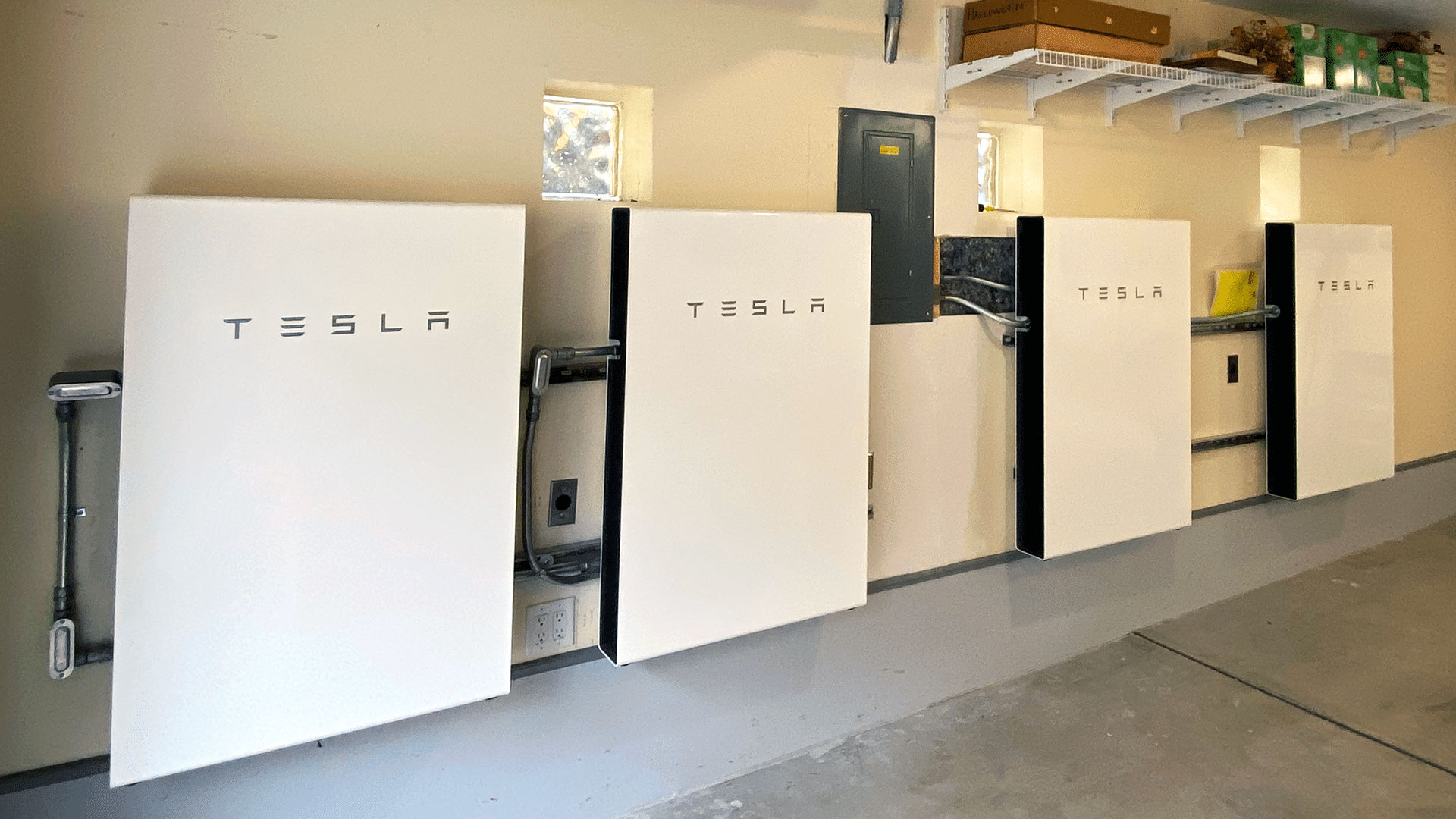
The Powerwall 3 counts as a domestic-content battery and integrates the solar inverter and battery in one unit, which lowers hardware cost. There is a real tradeoff worth knowing: when the PW3 serves as the system inverter, the solar side no longer counts as domestic content, which caps the discount below the 35% maximum. Pairing a PW3 with domestic-content Enphase or SolarEdge inverters is what reaches the top of the range. We model both.
A prepaid lease is only as good as the company holding title to your system for the next 25 years, so it is worth knowing who they are.
CEO Steven Pollock previously led Tesla’s energy organization. That background is visible in the product: the Tesla Powerwall 3 is central to how Participate designs and prices systems.
Founders Ethan and Lori Friedman bring a long track record in tax-advantaged energy transactions — the specific expertise a commercial ITC passthrough structure depends on.
The team has deployed more than 350 MW of rooftop solar across over 1,000 residential systems, so this is an established operator rather than a new entrant reacting to the residential credit expiring.
Every published term of the Participate Energy Prepaid Lease in one place, so you can compare it against a solar loan, a PPA, or a traditional energy service agreement without chasing a salesperson for answers.
| Term | Participate Energy Prepaid Lease |
|---|---|
| Product type | Prepaid lease, third-party owned. The prepayment may be paid in cash or financed through Credit Human. |
| Discount / rebate | 25–35% based on domestic content — in practice, 35% when both the solar and the battery are domestic content, and 30% when a Powerwall 3 serves as the inverter, which makes the solar side non-domestic. Up to 35% in Hawaii. |
| Dealer fee | None |
| Payment terms | Prepaid — there is no monthly lease payment. If financed through Credit Human, two products are available: UCC Secured at 120, 180 or 240 months, 8.99% APR, $7,500–$100,000; or Unsecured at 60 or 84 months, 9.99% APR, $2,500–$30,000. No dealer fee on either, and no prepayment penalty. |
| Agreement length | The solar and battery terms run separately: 25 years for solar, 10 years for the battery. |
| Purchase option | Available beginning at Year 6 and on each anniversary after, at a fair market value Participate establishes at that time. Because you have already prepaid 100% of the lease, the intent is a $0 or low incremental buyout — but a specific future figure cannot be guaranteed in advance. |
| FICO requirement | Not applicable to the lease itself when paid in cash. Credit Human financing is a separate credit product with real underwriting: Equifax is the primary bureau, with 680+ receiving instant approval, 650–679 going to manual review, and 649 and below declined. |
| Project cap | None. Systems designed above 135% of annual usage require a load justification form. |
| System size limit | No minimum and no maximum, and no pricing caps. The market sets the ceiling, since the customer funds the transaction. |
| Second systems | Allowed, but must be a new, fully independent PV system, completely separate from any existing solar on site. No AC coupling to existing equipment. |
| Eligible property types | Single-family homes and townhomes where the owner owns from ground to roof. Manufactured and mobile homes and apartments are not eligible. |
| Eligible roof types | Asphalt shingle, corrugated metal, standing seam metal, concrete or cement tile, EPDM, modified bitumen, and rolled asphalt. Other roof types are reviewed case by case. |
| Ground mounts | Solar-only ground mounts are not currently supported (recent guidance captures the substructure beneath the racking). A ground mount can work when it includes a Powerwall 3, which provides a safe-harbor pathway — so a battery is effectively required. |
| Occupancy requirement | None. The owner simply needs to execute the contract, so investment and non-owner-occupied properties are eligible. |
| Spanish-language contracts | Available |
| Roof work | Only the portion of the roof directly beneath the solar array is eligible for inclusion. Roof work outside that footprint is handled separately, outside the Participate contract. |
| Grid services / VPP | Participate owns and controls the asset in years 1–6. When a system is enrolled in a grid-services or VPP program, 70% of the proceeds go to the customer. |
| State & utility incentives | Only Participate-approved state incentives, which you can cross-check on DSIRE, can be included inside the prepaid lease. Many incentives, including certain utility rebates and RECs, flow directly to the customer instead. |
| Transferability | The agreement can be reassigned to a new homeowner with a straightforward transfer document, subject to the agreement’s transfer terms. |
| Insurance requirement | List Participate Energy as loss payee on your homeowner’s policy, or verify the policy carries no solar or battery exclusion. A rider insurance adder at 2.5% of total system cost is available only when coverage cannot be obtained through the homeowner’s policy; it is not automatically included. |
| States available | California, Colorado, Connecticut, Florida, Hawaii, Massachusetts, New Jersey and Texas. Illinois is expected soon. |
Terms reflect the Participate Energy program as of 2026 and are subject to change. Your specific discount, term and pricing are confirmed on your proposal before you sign anything.
Most disqualifications happen for structural reasons rather than financial ones. Here is what actually decides it.
Single-family homes and townhomes qualify when the owner controls the structure from the ground to the roof. Manufactured and mobile homes and apartments are not eligible. Condos generally fail this test because the roof is common area rather than owned by the unit.
Asphalt shingle, corrugated metal, standing seam metal, concrete or cement tile, EPDM, modified bitumen, and rolled asphalt are all accepted, and anything else is reviewed case by case. Solar-only ground mounts are not currently supported, though a ground mount paired with a Powerwall 3 has a safe-harbor pathway. Only the roof area directly beneath the array is eligible for inclusion in the contract.
Participate is live in California, Colorado, Connecticut, Florida, Hawaii, Massachusetts, New Jersey and Texas, with Illinois expected soon. Hawaii projects can reach the top 35% discount.
There is no occupancy requirement. The owner only needs to execute the contract, so rental and investment properties are eligible — unusual among residential solar financing programs.
Participate Energy must be listed as loss payee on your homeowner’s policy, or the policy must be confirmed free of solar and battery exclusions. If your carrier will not cover the system, a rider adder at 2.5% of system cost can be added — but only in that case.
A second system is allowed, but it has to be a genuinely new and independent PV system with no AC coupling to your existing array. Expanding an existing system under this program is not an option.
These screenshots are pulled directly from a real Participate proposal run on a Mission Viejo, CA home with an SCE utility bill of $426/mo. This is what your advisor presents before you make any decision.
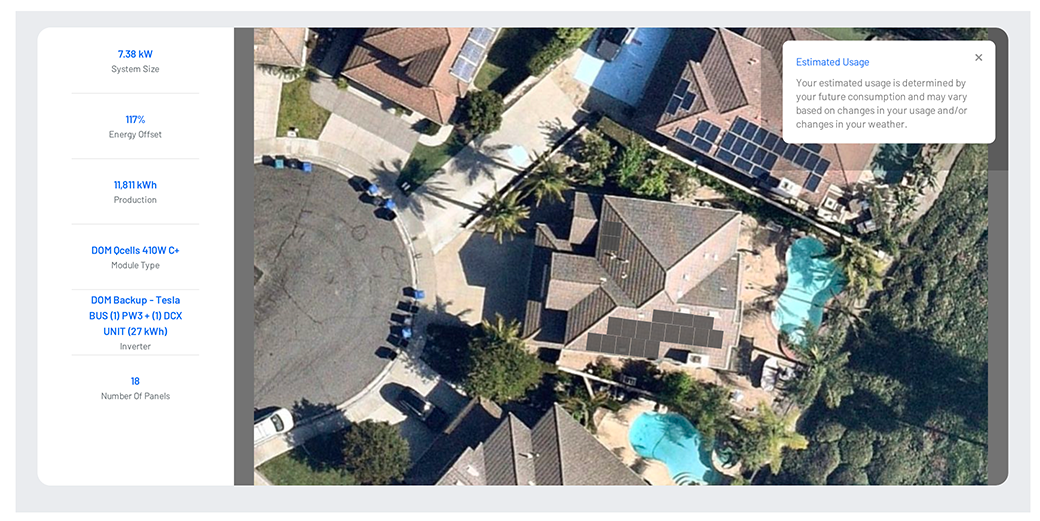
Satellite aerial of the actual home with panel placement. 18 Qcells 410W panels, Tesla Powerwall 3 + DCX expansion unit (27 kWh total storage).
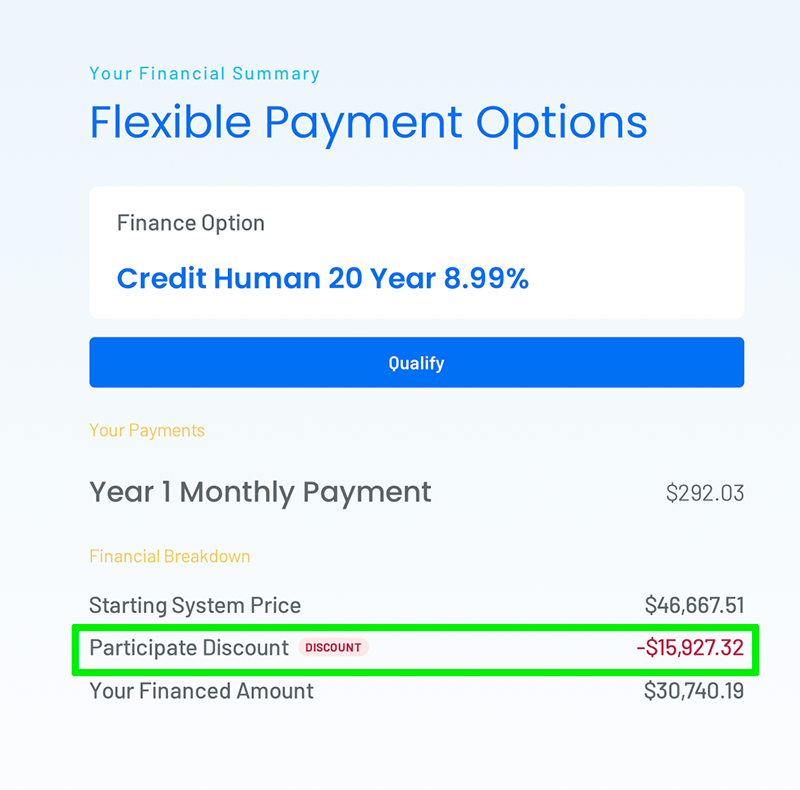
Starting price $46,667. Participate discount applied: $15,927 (34.1%). Amount financed via Credit Human: $30,740 at 8.99% APR over 20 years.
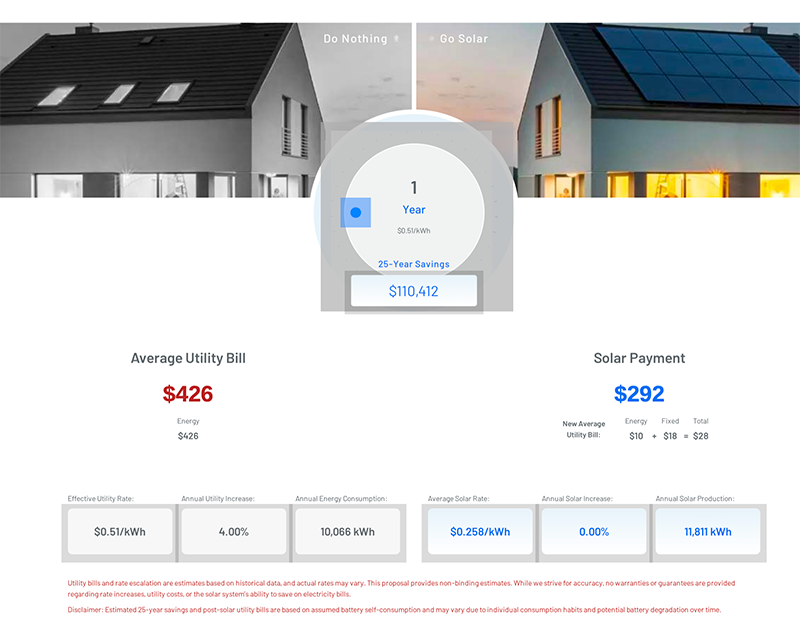
$426/mo utility replaced by $292/mo fixed Participate payment + $28 residual grid charge = $320/mo total. Saves $106/mo from day one.
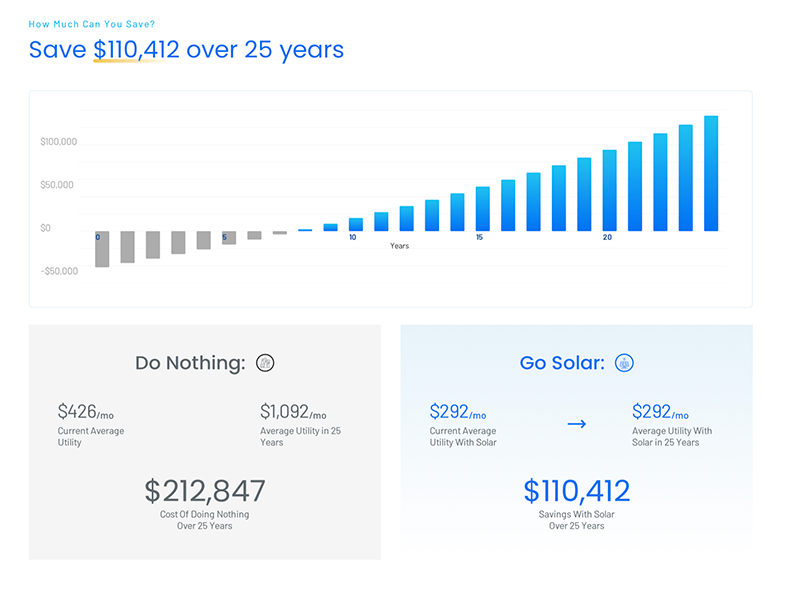
Utility projected at $0.51/kWh escalating 4%/yr. The Participate payment stays fixed. Gap widens every year. Total projected savings: $110,412.
All figures from an actual Participate Energy proposal. 25-year savings are estimates based on $0.51/kWh SCE rate with 4% annual escalation. Actual results vary by usage, system performance, and future utility rates.
Both products use the commercial ITC to deliver a real upfront discount. The right choice depends on your zip code and credit situation. See the full program comparison for complete details.
| Feature | Participate Energy | Propel by Concert Finance |
|---|---|---|
| Financing structure | Prepaid lease; pay cash, or finance via Credit Human at $0 down | Prepaid ESA + Concert Finance 25-yr loan, $0 down |
| Upfront discount | 25–35% by domestic content (~30% typical, up to 35% in HI) | 39.2% in Energy Community zip codes / 30% standard |
| Monthly payment | None if prepaid in cash; otherwise fixed via Credit Human (e.g. $292/mo on real proposal) | Fixed via Concert Finance loan (e.g. $279/mo on same home) |
| Loan term | 10, 15 or 20 years (all 8.99% APR, no dealer fee) | 25 years |
| APR (real proposal) | 8.99% | 8.99%* |
| Credit check required | None for the lease itself; Credit Human financing has its own requirements | Yes, 660 FICO minimum |
| UCC filing on equipment | None on the lease itself or on a cash prepayment; Credit Human’s UCC Secured loan does file one | UCC-1 on equipment (surfaces on title at sale) |
| Battery hardware | Tesla Powerwall 3 | Enphase IQ Battery 5P |
| Ownership pathway | Purchase option at Year 6 (fair market value) | Auto-transfer at Year 5, no extra cost |
| 25-yr savings (same Mission Viejo home) | $110,412 (winner on this non-EC address) | $100,987 |
| Best for | Non-EC zip codes, cash buyers, credit-constrained buyers, rental and investment properties, Tesla Powerwall preference | Energy Community zip codes (39.2% discount wins) |
Straight answers on the structure, the discount math, the Credit Human terms, eligibility, and the parts of the agreement that are easy to misunderstand.
We run both Participate and Propel on your address, your utility rate, and your roof. You see both sets of numbers before making any decision.